Sunday, June 29, 2014

Dragon Age: Inquisition (What We Know So Far: Comprehensive Update)

 
It has been awhile since the last What We Know article and a great deal of information has come out since then.  Be forewarned of spoilers from the previous games and published materials below [I added a couple of tidbits of detail June 30th, noted in square brackets below].
 
We'll start in the beginning with the premise: Dragon Age: Inquisition takes place three years after the events of Dragon Age 2; the events in the books Asunder and The Masked Empire occur right before the game (the former looks at the mage-templar conflict, while the latter focusses on the Orlesian civil war).  It is not a direct sequel to either prior game, in the sense that you are playing either Hawke or the Hero of Fereldan, but the events of those games impact what occurs (more on that below).  Cameron Lee offers a succinct description of the premise (via Nerd Alert at E3):
You are at a peace conference between the mages and the templars...and a massive explosion happens--wipes out everyone [but] you get blasted into the Fade--which doesn't normally happen, people don't go physically into the Fade, but you do, and as a result of that you become marked.  So you have this mark on your hand and it allows you to manipulate the Fade in various ways--there's a big breach in the sky between the Fade and the real world--demons are pouring through, lot's of little rifts opening up all over the place, and because of that mark, you're really the only one that can actually do something about it, but the other weird thing is that chaos is starting to spread all over the world--different nations are in chaos, different factions have been weakened, people are at war with each other--which is all very convenient.  So as a player you get to form an Inquisition, which is a big organisation full of soldiers, spies, merchants, politicians, all with the goal of uncovering the truth of who is behind this, what is happening, and then bring stability to the world.
 
Lee was more specific about the opening itself with AusGamers:
At the beginning of the game when the head of the Chantry and the head of the Mage's faction they're going into the Temple of Sacred Ashes to this peace talk, and they're all killed. There's this massive explosion and this breach in the sky opening up, and the Chantry's in absolute chaos. It's headless. You've got infighting between different factions, you've got people saying screw it let's all retreat back to Val Royeaux and elect a new leader et cetera. So the formation of the inquisition is kind of always like a plan B that the head of the Chantry was considering, and then Cassandra starts to bring this all up after the events at the temple. And she's doing that because she knows that the Chantry was considering it and that the Chantry is just going to run off and talk about stuff rather than taking any action. So she sets things in motion via this loophole, picking up the Inquisition.
 
Along with the tear in the Fade and war between the mages and templars, there's a civil war in Orlais between Empress Celene and Grand Duke Gaspard de Chalons (along with an Elven rebellion in Hamalshiral), "The Empire is falling apart" (to quote Asunder).  The war is at the heart of The Masked Empire novel, but the book does not resolve the conflict.  None of the information provided by the developers has touched on the specifics of how this material will impact the Inquisition (albeit from the E3 teaser from last year we can deduce Morrigan is involved), so it's difficult to judge how much the Inquisitor will deal with it directly (some believe Briala from the aforementioned book is shown in the concept art below, but that's just speculation).
 
 
I'd initially been under the impression that the Inquisitor founds the Inquisition, but Mary Kirby makes it clear that it's Cassandra who creates the fledgling organisation.  In the game lore, the first Inquisition was formed with:
[the] goal of protecting the people from the tyranny of magic in whatever form it might take; blood mages, abominations, cultists or heretics. A loose association of Andrastian hard-liners, the group combed the land in search of these threats and some say theirs was a reign of terror. Others say they were cast in a negative light by history because their investigations and even application of justice, protecting both mages and common people impartially, crossed too many powerful groups. In these accounts it is suggested that the group was already known as the Seekers of Truth and that the "Inquisition" moniker was perhaps pejorative
In the real world "Inquisition" is a loaded term (something I explored awhile back), and that's quite intentional.  While your Inquisition might not be torturing unbelievers like the historical version, it could be a very hard, harsh organisation (including abandoning innocents to their fate, ala the Crestwood demo from last year).  Regardless, as the Inquisitor you have a great deal of political power:
you have rights and powers that other citizens don't have, and you can use those to great effect. At the same time you also have to make decisions, moral decisions, about what's going to happen.  Do you want to save a village from burning, or do you want that village to burn down?
 
 
Lee added an interesting tidbit about the Mage-Templar conflict:
You can bring it into the conflict between the mages and the templars once and for all very early in the game, and you can align with one of those--you can decide who you want to bring into your Inquisition.  When you make that choice you will see large pieces of content which are exclusive to that choice.
So there are two branching paths right at the beginning of the game--choosing a side, or attempting to mediate between the two--albeit given that there's a main antagonist the conflict is a symptom rather than cause of all the difficulties.
 
Who is the Inquisitor?  A male or female of any race (Human, Dwarf, Elf, or Qunari), whose only restrictions are that Dwarves cannot be mages, Elves must be Dalish, and the Qunari must be Vashoth (those never part of the Qun)--the Elven restriction is the only one I find puzzling, but I'm sure there's a good reason for it.  The surnames from each race are also set and have been revealed (via the Crestwood demo; the same order as above): Trevelyan, Cadash, Lavellan, and Adaar.  The surname with the most direction connection to past player experience is Cadash, as that's Shale's background (DAO: The Stone Prisoner DLC).
 
 
Who joins the Inquisitor as part of the Inquisition?  The entire group has been shown and only one remains unidentified.
 
 
Left to right: Cullen (DAO-DA2), Vivienne, Varric (DA2), Cole (Asunder), Solas, Cassandra (DA2), Iron Bull, Dorian, Leliana (DAO-DA2), Sera, unknown, and Blackwall.  There are official bios on the website for the majority of those above--interestingly, all the characters from 2012's survey leak are present and unchanged.  Not all of the characters above will be companions, as there are only nine, with Cullen, Leliana, and the unknown woman being NPC's.  The companions consist of three's--three warriors, three rogues, three mages, and three women; I believe each NPC fits each class (warrior, rogue, mage).  In all we have two Elves, a Dwarf, a Qunari, and Cole (who seems to be a spirit made flesh).  The gender split is close (7 to 5), albeit 6 and 3 when it comes to companions (not the biggest of deals, but an interesting choice).
 
Assembling this group happens quite early in the game (within the first 30 minutes if I remember correctly) and it is possible to miss out on one or two.  Mike Laidlaw and Mark Darrah (same link) also confirmed you can lose companions--down to one apparently if you make an effort to chase them away (I'd guess Cassandra is the core person who remains until the end).  The image above is suggestive of The Last Supper, but thus far I believe the similarities are superficial (especially given the Round Table look in the Stand Together promo; I did look at the former implication which you can read via the link above).
 
 
Mike Laidlaw talked about the team being inspired by Game of Thrones for the characterisation:
I think that where Game of Thrones really shines, is with characters that you really care about and that are human, but flawed—and that's something that we've always strove for as well. Fantasy works well when you have people, people with all their ups and downs grounding against the wacky, you know, the mages and the demons and what have you…that's something that Martin does really well in my opinion. He makes characters that even though academically you know they're the bad guy, or academically you know they're wrong, he puts you in their head and helps you to understand whats going on with them.
And what about romances?  Mike Laidlaw, when pressed on Twitter to confirm that there were more romances in the new game than Dragon Age 2 including the DLC (Sebastian), backpedaled:
Remind me to never use numbers when discussing the game. They are debated endlessly. Pretend I said, "lots."
Does this mean there are less or the same?  It's not conclusive, since Laidlaw may not remember the exact number off the top of his head, but his qualification is worth keeping in mind.  DA2 has 5 romances (Isabella, Merrill, Anders, Fenris, and Sebastian), while for DAI we currently have Cassandra and Cullen (no gender preference, if any, has been stated), Dorian (for male inquisitors [here's a great reaction to that from angelarts]), and Sera (for female inquisitors) confirmed with more to come (the Iron Bull is heavily implied).  Cameron Lee discussed the mechanics of romance:
Romances are not about this sort of gamey approval rating; right so it's not like you can give people flowers and then sleep with them. Romance is a more nuanced and more organic and natural.  There's these characters there with strong personalities with their own goals, [so] how you interact with them and how [you] may help or hinder or whatever their goals plays a part in that--a part in how your relationship builds with them as a "normal" relationship; and then from there what part do I want to take.
Along with the core group of followers, the Inquisitor is in charge of a large number of men and women, the most significant of which are called agents.  Cameron Lee explained the concept to gamermd83 and the essentials follow (second paragraph is from AusGamers, link above):
You earn agents as you essentially build up your Inquisition, and then from that you can use your agents and use that influence and power you built up through the Inquisition to do a variety of things: it could be hey go and get me this rare crafting material, it could be repair this bridge...it could be I want to go and start to look into this main part of the story. ... There are hundreds of operations that you can send your agents on, and those operations will change depending on the actions and decisions you make throughout the course of the game. ... To progress through major parts of the story you have to have a certain amount of influence, your Inquisition needs to have a certain amount of strength.
All throughout the game you will slowly build up the Inquisition to be in a position of power, people recognise you for who you are and what authority you wield. The Inquisition has three main pillars right, they have a military force lead by one particular character [Cullen seems like the obvious choice here], you've got a secret facet with spies and assassins lead by Leliana from DAO and then you've got a political pillar, which is all about the politics, the backroom deals and the connections you have... not just through nobles but also through merchant houses and stuff like that. And the area you decide to invest in both in terms of how you decide to grow and customise your Inquisition but also the types of content you decide to engage in is all up to the player. So if someone wants to play that kind of Game of Thrones-y political aspect they can definitely do it and that flavours the whole game and it impacts the whole game. They're still going to have to go around and kill some things themselves, but having that powerful political organisation will be reflected as well.
We'll also be sending out companions (and NPC's) on various missions throughout the game (the best demonstration of this was the E3 demo, which can be seen a number of places in interviews including the link above from IGN).
 
 
Along with the characters above, others from previous games have been confirmed: Morrigan (from DAO; she was featured in the E3 teaser from last summer and apparently she'll be more "mature"), Flemeth (DAO-2), Alistair (DAO-2), Dagna (DAO), and Queen Anora (DAO).  The Alistair inclusion will not occur for those who sacrificed him in Origins.  There's also an unidentified character from the novel The Masked Empire who can be encountered in a side mission (most likely Ser Michel, although possibly Mihris or even Imshael).  It's hard to imagine Empress Celene and Gaspard du Chalons won't make an appearance.
 
The developers have hinted that Hawke and the Hero of Fereldan (if alive) will be referenced in some capacity, but in my opinion they won't appear given the huge amount of variables those characters can have (even though cameos have been reported, later changed to a "solid possibility"; I don't believe that means they will appear in person).  Steve Butts at IGN gives us a hint at the kind of thing we can expect while describing the E3 demo: "You’ll be able to claim the banner points in the game in the name of the Hero of Ferelden."
 
Returning to the question of the backdrop of DAI, what about our prior actions in DAO and DA2?  These can be carried over via the Dragon Age Keep.  As Lee explains:
What we wanted to do with the Keep is have that ability for people to be able to recreate their save -- particularly for Gen 4 platforms -- and that's quite a detailed list. There's hundreds and hundreds of choices in there, and most of it's narrated and there's pictures and text and stuff like that. So they should be able to recreate to the same detail their save file through that Dragon Age Keep online process, and then pull that save game down onto any platform.
In the Nerd Alert interview (link above) Lee said there's about 300 different choices to be made (the site includes narration, animations, story and lore--more may be added, although it's unlikely to impact elements in the game at release).  Lee also said decisions made within DAI will be uploaded to the Keep to be used in future games.  There is a default background for newbies or those who want to start fresh: a Dalish Elf was the Hero of Fereldan (Origins) and died ending the Blight (Alistair becomes king), while Hawke is a mage (Dragon Age 2) and sided with them against the templars.
 
What about various dangling plots, like the Architect (DAO: Awakening), Morrigan's Old God Baby (Origins), or Corypheus (DA2: Legacy)?  They are unlikely to significantly impact the Inquisition storyline given that it can be played without those elements available (the Architect could be dead and the Hero of Ferelden may never have had the Old God Baby with Morrigan).  However, those plot lines will be addressed in some way if they were involved in your story.  As Cameron Lee explained last September (specifically in reference to the Old God Baby):
If players did decide to have a kid with Morrigan, and not all of them did, so that's the thing--I can't talk too much about it, unfortunately--but, you know, certainly if you were to have a kid, you know, that would make you a little bit more human, I would imagine, so you might see something about that.
 
The locations for DAI have been almost completely revealed, as IGN describes:
Stretching over two nations [Orlais and Ferelden] with 10 unique terrains ranging from forests to deserts, swamps to mountains, Dragon Age: Inquisition will be absolutely massive when compared to the previous two games. “This is the biggest game in our studio’s history,” Darrah told us. “It’s the largest RPG we’ve ever made. There is more story-based content in Dragon Age: Inquisition than any other BioWare RPG." Noting that this is the first open-world game from BioWare, Mark also let us know that Inquisition “will set the bar for all of our future games.”
I believe the 10 unique terrains equates to 10 significant locations, but that must remain inference at this point.  Ferelden (the setting of DAO) and its neighbour Orlais (which includes the Dales) are the nations in question.  We know of the following locations either via the official website or the Crestwood demo (listed roughly east to west):
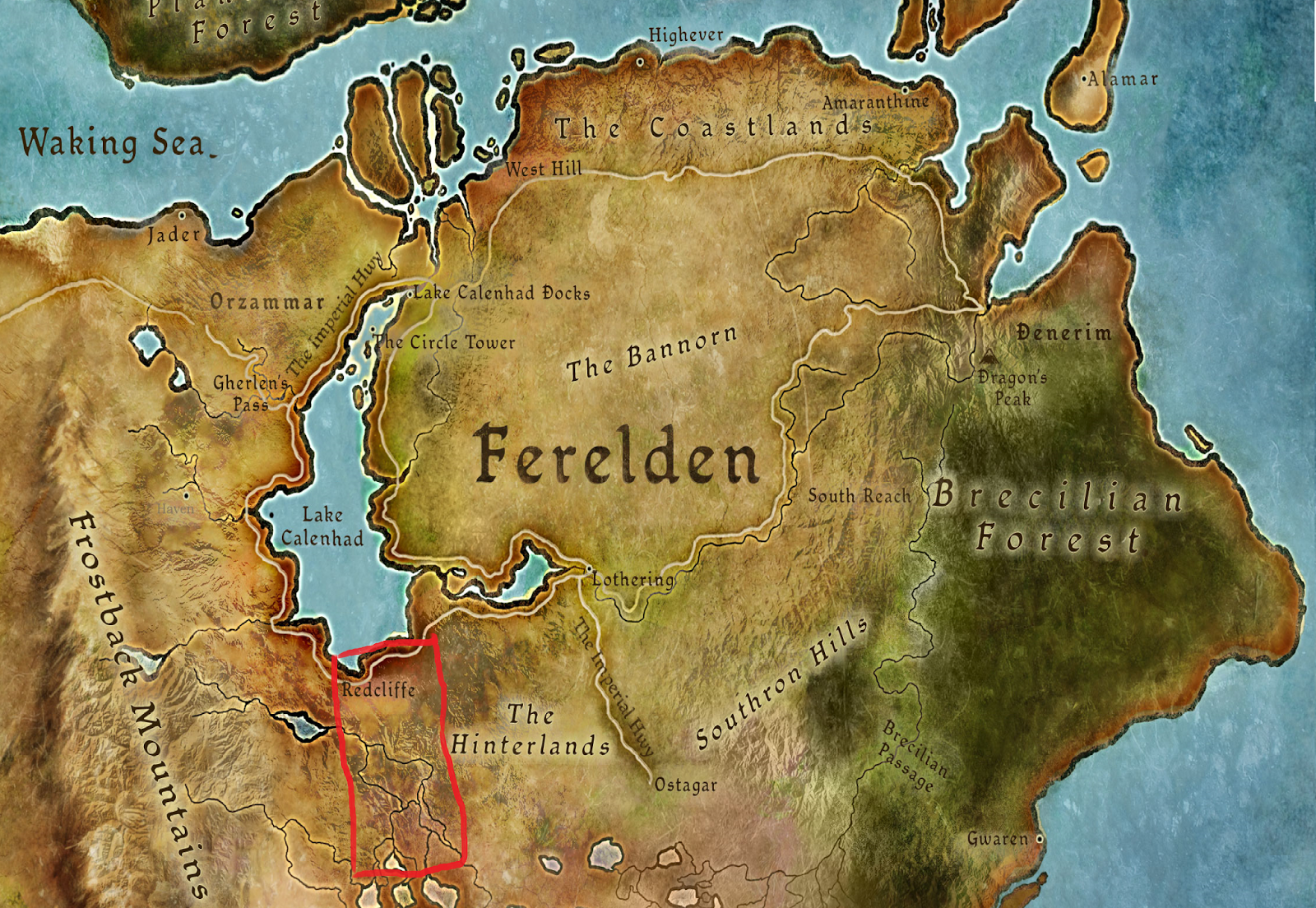
-The Hinterlands (confirmed, Ferelden and includes Redcliffe; appeared in the E3 demo)
-Crestwood Hills (confirmed via the Crestwood demo; it's in Ferelden; appeared in the PAX demo)
-Frostback Pass (confirmed via the Crestwood demo; may include Orzammar)
-Therinfal Redoubt (confirmed, although where in Ferelden is uncertain)
-Halamshiral (confirmed, in Orlais and presumably part of a larger region)
-Emprise du Lion (confirmed; within the Dales)
-Exalted Plains (confirmed; within the Dales)
-Emerald Graves (confirmed; within the Dales, likely near or in the Arbor Wilds area)
-The Southern Desolation (confirmed via the Crestwood demo; almost certainly in Orlais)
-The Western Approach (confirmed, Orlais and includes Griffon Wing Keep and the Fortress of Adamant; appeared in the PAX demo; the fortress is featured in Asunder)
-Nahashin Marshes (confirmed via the Crestwood demo)
-The Fade (confirmed)
This makes for 9 of 10 locations (Therinfal and Halamshiral are within larger areas), 10 if the Fade is included (although I doubt it counts as a place of exploration and expansion of influence for the Inquisition).  What these areas do not include are the Heartlands of Orlais (containing the majority of large settlements), while consisting of the western slice of Ferelden.  For the map below the actual areas will be much smaller, but it's the approximation I'm aiming for; the numbers match where they are listed above, excluding Halamshiral and Therinfal.
 
 
The point about the size of areas is worth emphasizing.  We know from the demo's that the Crestwood Hills region is bigger than all of Dragon Age 2 combined (apparently 15 minutes in-game to walk from one end to the other), while the Hinterlands are bigger than all of Dragon Age: Origins combined.  Interestingly, the latter is described as medium-sized, which suggests that Crestwood is (relatively) small and that there are much bigger environments.  The girth of these areas is meant to give us the open world experience.  As Mike Laidlaw explained to joystiq's Susan Arendt:
"In each level, I wanted there to be at least one cave, one dungeon, one something that no-one tells you to go to," he explained to me. He said that his design team had to "break some old habits" as they were creating the enormous open world that would become Inquisition. Dragon Age: Origins and Dragon Age 2 both made sure the player knew about every last thing they could possibly do, and Laidlaw wanted to make sure not everything was quite so obvious. It meant that there might be content in Inquisition that might never be seen, but it also meant that there was a point to exploring the game's stunning locations beyond just hitting the next point of interest on the map.
To traverse these large areas players will have access to mounts for the first time in the Dragon Age franchise (from a basic horse to a creature that looks like a cross between a nug and a water buffalo, a lizard of some kind (referenced at E3), a red hart (not a halla), and bog unicorn (both via the deluxe edition), but there will be no mounted combat as Mark Darrah explains:
the feature was deemed to be out of focus with the series’ core combat systems. After all, players already have additional party members and Dragon Age’s combat emphasizes the use of tactics to properly utilize the different companion characters. The developer chose to continue to focus on party mechanics instead of adding mounted combat into the mix and potentially altering a setup that is already proven to work. Aside from game design, Darrah also revealed that the inclusion of a mount system in general was something that the developer wanted to be careful with since it is new to the series. Adding mounted combat on top of everything else would also require the new mechanics to be built from the ground up on the game’s Frostbite 3 engine. Ultimately, the time and resources necessary to accomplish the task wouldn’t have been worth the effort for a feature that wasn’t deemed to fit well inside the game to begin with.
While the Inquisitor is mounted his companions will disappear until you dismount.  I also have a suspicion that one of the ways we'll bounce around between locations is via Eluvians (this is not a unique thought), now that they have been re-activated (The Masked Empire)--if that surmise is correct, Briala would definitely be involved since she currently controls them.
 
To make the open world dynamic, the devs have incorporated a world master system.  The emergent system will reflect the changes you make in the environment, so if you (for example) extensively hunt bears in an area, their population will be depressed or go extinct (the same goes for resources you might gather).  As Cameron Lee explained:
We have the World Master system, which flows into everything from creatures to NPCs to bandits. The player has, for example, driven out a particular faction from an area – based on decisions and actions they take – and another faction may move in and take their place
The comment about factions is interest and I'm curious to see how that changing dynamic will work in-game.  As for resource collection, what's our motivation?  Two things: 1) to take advantage of the expanded crafting system, 2) the changes in DAI that will prevent players from amassing hordes of healing potions and auto-healing between encounters (thus requiring crafting).  Lee (same link) discussed the new system:
Generally how it works is you have kind of like a template, and that template could be for armour, or it could be for weapons or other pieces of equipment.  You can insert different metals, different materials, into the different slots of that template and that will keep the shape of the item, but it will change the physical characteristics of that item--so it will change the look, it will change the stats, so you can really customise how you look and how you're building your character.
This customization extends to bases--some of which are purely aesthetic, but others have game impacts.  Some of these game-relevant mechanics are discussed in the PAX demo from last year, where bases can have a focus (military, diplomatic, or economic) and each has its own set of advantages (the specifics of which have not yet been fully discussed).
 
As for classes, the selection is familiar: Warrior, Mage, and Rogue.  Each has three specialisations, not all of which have been delineated, but should allow enough flexibility to provide variation in play styles and for everyone to find something that suits them.  It's difficult to truly dig into the specifics until more is revealed, so I'll bookmark that for now and come back to it when more information is released.
 
[Some housekeeping I missed when I posted this via the BioWare forum:
-Skyhold Keep will serve as your "party camp" location, as well as the base of the Inquisition. It is at least partially customizable.
-All of your companions will be there (like in DA:Origins), so you don't have to run around the map finding them (like in DA2).
-There will also be several others keeps/castles/strongholds you can take throughout the game to serve as a strongholds for the Inquisition. It is unknown if these will also function as companion-interaction locations, or if you will have to return to Skyhold for that.
-You will be able to change your companions armor and weapons (even weapon types), although they will maintain a sort of "personal style" to anything they wear.
-Combat will be far more tactical, placing emphasis on elements such as positioning, elevation, chokepoints, and preparation, with a strong focus on teamwork.
-There will be no level scaling. This means that you may encounter areas or enemies that are too difficult, and you'll have to come back to them when you are stronger.
-For dialogue there are three possible "wheels" that you can encounter during the game: The Tone Wheel is the "standard" option that you see most often in DA2. You are selected dialogue for the purpose of conversation and exposition. Your character's choices reflect his overall attitude and demeanor. The tones from DA2 (Diplomatic, Sarcastic, and Aggressive) have been replaced with Noble, Clever, and Direct; the Action Wheel is for making a hard-line choice between two (or more) options. It is not tone-based (such as the Accept/Deny quest options in DA2), and all options are "neutral" in terms of tone. To avoid confusion, each option will tell you explicitly the intent of the selected option; the Reaction Wheel is for reacting emotionally to a situation. Instead of choosing your tone, you choose an emotional reaction (such as "Sad", "Enraged", "Confused", etc.). The "Stoic" option is always available for a reaction-neutral response.
-Conversation will also be more dynamic, allowing you to just walk away mid-conversation.]
 
What about our antagonists?  We know there's a hidden figure behind the tear in the Fade, but besides that person (or creature), who will the Inquisition be fighting?  The Red Templars have been very prominent in released material.  This group seems to represent the templars who are fighting the mages and have made the switch from regular lyrium (supplied by the Chantry until the Navarran Accord is annulled by Seeker Lambert in Asunder) to red lyrium (the substance discovered in Dragon Age 2 that drove both Meredith and Varric's brother Bartrand mad).  I'd guess their goals are more extreme than simply defeating the mages.
 
 
Another group featured in released material are the Venatori cultists, who appear to be the extremists on the mage side of the equation.  They use Tevinter symbols, but it's not clear if they have formal support from the Imperium (perhaps what's been meant when I heard that Tevinter mages are enemies to be encountered--one was featured in the recent E3 demo).  There's certainly reason to wonder if they have a connection to Corphyeus (see above), given that players neither decide his fate nor need to have played the DLC he's featured in to be involved--why else set up a story in which he always escapes?  Still, it's idle speculation on my part as there's no specific evidence to suggest his involvement.
 
Along with these two factions there will be demons, dragons, and bandits to fight, along with dealing with Orlesian politics (including the Elven rebellion).  Mike Laidlaw briefly mentions the political element to Machinima, saying there was crossover from The Masked Empire, but didn't get into specifics, so as it stands the mage-templar conflict seems like the main organised groups to be confronted.
 
 
As for the gameplay itself, the story can be played through in 40-50 hours for those who eschew side quests and speed through the main story line; overall there's 100 hours of play available.  The devs don't expect you to be able to do everything in one playthrough (indeed, given that some choices close off possibilities, this seems impossible).  There are a few unique endings, along with about forty major variances based on your choices (there are hundreds of minor differences beyond that).  Also of interest, there's content intended to be played after the main plot is wrapped up:
the preview states that most of the content in Emprise Du Lion is so difficult that the player won’t even be able to experience them until the post-game, implying that there is going to be more content for the player to explore even after the campaign has ended.
As Cameron Lee told Rock Paper Shotgun:
There’s a whole area in the game – it’s one of the highest level areas in the game, we kind of designed it for people to play after they finish the story – that’s kind of a pitched battle. So you and your party come through and push the enemy back and back, further throughout the whole area. And from that, the village that’s nearby changes. Maybe there’s more merchants on the roads and stuff like that, which then affects the in-game economy as well. It’s quite a complex and dynamic system. 
One thing we won't get before the October 7th release is a playable demo, as Allan Schumacher explained to Game On:
[He] explained that putting together a demo would take time and resources away from the main development of the game. With that in mind, the task of completing Dragon Age: Inquisition itself has been given prominence over taking people off of the project in order to create a demo. [He] clarified that work on both of the series’ previous entries were completed in time to allow the team to build their demos. With Dragon Age: Inquisition, however, the developer is in a much different situation as there is still work to do before the game’s launch. Before the title releases later this fall, fans will get a chance to setup their game save early as Bioware plans to launch the Dragon Age Keep before the game comes out. The Keep will let both new and returning player dictate how past events transpired in the recent history of the Dragon Age universe. The web-based app will be used exclusively to determine player decisions from the first two games in the series as opposed to imported existing save files.
To me this isn't a big deal, but I can see it being a source of criticism prior to release.

That's all the information I've been able to find.  If there are any omissions or errors please let me know.
 
This article is written by Peter Levi (@eyeonthesens)

Friday, June 20, 2014

Dragon Age: Inquisition News Update (June 20th)


News has been trickling out slowly since the end of E3 and what follows is all the info I could find along with some thoughts and speculation.  Incidentally, EA has once again pulled down the E3 demo from YouTube (although here's a new link for it), but I'm sure it will go up again soon.  It's an odd insistence from the company given that it's a less comprehensive and story-filled demo than the old one PAX last year that you can watch at your leisure.
 
Freddie Prinze Jr. was announced as the voice of Iron Bull; I quite like what I've heard of the voice he's using for the character.  Much like Claudia Black (Morrigan) Bioware gave Prinze his first chance in the VO business (with Mass Effect).
 
Allan Schumacher explained to Game On why DAI won't have a playable demo (unlike the previous installments of the franchise):
[He] explained that putting together a demo would take time and resources away from the main development of the game. With that in mind, the task of completing Dragon Age: Inquisition itself has been given prominence over taking people off of the project in order to create a demo. [He] clarified that work on both of the series’ previous entries were completed in time to allow the team to build their demos. With Dragon Age: Inquisition, however, the developer is in a much different situation as there is still work to do before the game’s launch. Before the title releases later this fall, fans will get a chance to setup their game save early as Bioware plans to launch the Dragon Age Keep before the game comes out. The Keep will let both new and returning player dictate how past events transpired in the recent history of the Dragon Age universe. The web-based app will be used exclusively to determine player decisions from the first two games in the series as opposed to imported existing save files.
This doesn't bother me, but I can see it as a source of criticism prior to release.  What's interesting is that the game seems to need every last second for completion, with less time for such promotional material as before--given that DAI was originally slatted as a 2013 release, one wonders what elements specifically has the group on such a tight schedule.
 
Mike Laidlaw confirmed that the Skyrim-like compass that was visible in the Crestwood demo has been removed (it was not to be found in the E3 demo), saying:
Wasn’t working for us, so we changed to a radar-style. Better for battles.
I wasn't a fan of the compass in Skyrim so I think it's a good choice.
 
Speaking of Laidlaw, when pressed on Twitter to confirm that there were more romances than Dragon Age 2 including the DLC (Sebastian, Tallis) he backpedaled:
Remind me to never use numbers when discussing the game. They are debated endlessly. Pretend I said, "lots."
Does this mean there are less or the same?  It's not conclusive, since Laidlaw may not remember the exact numbers off the top of his head, but it's worth keeping in mind.  DA2 tops out at 6 romances (Isabella, Merrill, Anders, Fenris, Sebastian, and Tallis), while for DAI we currently know Cassandra, Cullen, and Sera (for female inquisitors) are available.
 
I speculated back in May that Queen Anora would appear in the game and Mika Simmons (her voice actor) has confirmed that's the case.
 
Cameron Lee told Angry Joe that there are currently 20 dragons (high dragons) in DAI.  Lee also revealed (to PlayStation Access) that there's a mount that looks like a cross between a nug and a water buffalo (!), which joins the lizard referenced at E3, the default horse, and the announced mounts from the deluxe edition (red hart (not a halla) and bog unicorn).  From there he discussed the crafting system:
Generally how it works is you have kind of like a template, and that template could be for armour, or it could be for weapons or other pieces of equipment.  You can insert different metals, different materials, into the different slots of that template and that will keep the shape of the item, but it will change the physical characteristics of that item--so it will change the look, it will change the stats, so you can really customise how you look and how you're building your character.
Lee also discussed the World Master system in detail, although it reiterates things we've heard before (the emergent system will reflect the changes you make in the environment).  He also implied that Alistair's appearance in the game depends on your choices, so it does look like his death (if that's what happened in your game) would carry over into DAI.
 
I have a few thoughts on locations: I've been second-guessing gamermd83's Kal'Hirol theory lately and while it's still viable (and interesting), it's worth pointing out that the primary evidence for it (the waterfront shots and the Cadash family background) are easily transported to Orzammar--it's near both Lake Calenhad and the Waking Sea, and survivors of the Cadash family reside there.  Both possibilities remain speculative, but given the known geography of DAI thus far (see below) Amaranthine (Kal'Hirol) seems a bit isolated from the rest of the action as opposed to the confirmed Frostback Pass (which might possibly include Orzammar itself).

A couple of confirmed areas cannot be definitively put on the map yet (the Southern Desolation and the Crestwood Hills), but we can speculate on where they are.  With the former, the name tells us it's in the south and given that southern Ferelden is filled with the Kocari Wilds and Brecilian Forest, that kingdom doesn't enter the equation.  There's not much room in southern Orlais for it, but I'd guess it's sandwiched between the Western Approach and the Dales (perhaps part of the Deauvin Flats).  As for Crestwood, we know it's in a hilled area of Fereldan (as confirmed in last year's demo).  These are the options for hills: the flanks of the Frostback Mountains; the Southron Hills (which has Lothering on one side and the Brecilian Forest on the other), and The Coastlands.  Given that there are huge mountains seen in the demo I'd wager it's near the Frostback's.
 
With ten locations (regions) confirmed, but only eight revealed thus far, it will be interesting to see where else the Inquisition will roam.  Other than Halamshiral (not yet specifically attached to a region) there's no significant urban area, so a city might be one such; it's also possible the Fade, the Deep Roads, or a thaig might be one of the areas (I'm on the fence with the Fade being one--will we truly be able to explore it?  Doesn't quite fit the MO of the Inquisition).


A point about the size of areas is worth emphasizing.  We know from the demo's this year and last (here's the link for E3) that the Crestwood Hills region is bigger than all of Dragon Age 2 combined (apparently 15 minutes in-game to walk from one end to the other), while the Hinterlands are bigger than all of Dragon Age: Origins combined.  Interestingly, the latter is described as medium-sized, which suggests that Crestwood is (relatively) small and that there are much bigger environs yet to be revealed (we know the Western Approach is bigger than Crestwood, again via the old demo, but otherwise there are no specifics).
 
Jenni Lada at Technology Tell is pleased with DAI's diversity, which is worth highlighting in an industry heavily (and rightly) criticised for its default approach.
 
It's early (the game is still Alpha), but I wanted to touch on current (albeit rare) criticism of the game from people like Phil Owen at Game Front.  His critique is not particularly interesting, but I picked it as a fuller version of the what I thought Jesse Cox was referring too when he was Tweeting from E3 (it turns out, from his rambling explanation on the Co-Optional Podcast, that Jesse's main complaint is that the effects don't look next gen to him--comparing them to Skyrim).  Back to Owen, he feels DAI is too generic in its approach--he wants more uniqueness (using DA2 as an example, interestingly enough; something echoed by MrBtongue months ago).  This argument makes a false equivalency--the fact that a game shares traits with others (he compared it to the plot of the Elder Scrolls' Oblivion's) doesn't mean they are the same thing (it's like comparing The Lord of the Rings to the Dragonlance trilogy--they might both be fantasy trilogies, but as works of literature they couldn't be more different).  Even if DAI was self-consciously imitating another game, it's execution of the plot is what matters.  Owens' is also assuming uniqueness is required for something to be good (or better), and there's simply no justification for that.  Uniqueness has nothing to do with quality, but a lot of critics who become over saturated by their exposure to the market are desperate for new experiences and occasionally mistake "new experience for me" as "good".  It's not a surprise that the Dragon Age franchise went with a reliable, high-fantasy plot given the withering criticism they suffered for the less traditional DA2.  This may be self-evident, but it's worth keeping in mind when serious reviews begin in October.
 
This article is written by Peter Levi (@eyeonthesens)

Friday, June 13, 2014

Dragon Age: Inquisition What we Learned from E3

E3 has come and gone and provided us with a pair of promotional videos (the Lead Them trailer and the Stand Together video; the latter featuring the female Inquisitor and also showing the "war table" as more of a Round Table than a Last Supper imitator), two demos, and a ton of information.  As always, spoilers below.


Mike Laidlaw talked to joystiq's Susan Arendt about the size and scope of the game and wanting to create enough content to give it replay value:
"In each level, I wanted there to be at least one cave, one dungeon, one something that no-one tells you to go to," he explained to me. He said that his design team had to "break some old habits" as they were creating the enormous open world that would become Inquisition. Dragon Age: Origins and Dragon Age 2 both made sure the player knew about every last thing they could possibly do, and Laidlaw wanted to make sure not everything was quite so obvious. It meant that there might be content in Inquisition that might never be seen, but it also meant that there was a point to exploring the game's stunning locations beyond just hitting the next point of interest on the map. 
The point has been made by the devs that all the discovery and bits of story available relates to the major plots, something I've found lacking in other open worlds.
 
Laidlaw also said there were more romances in DAI than in any previous game, which, given that DA2 had five (including DLC Sebastian) sets the bar.  I'm not sure that means each Inquisitor will have six plus options, but rather there many available in-game in total.
 
[A quick add: Steve Butts at IGN tells us "You’ll be able to claim the banner points in the game in the name of the Hero of Ferelden," which is the first definitive thing I've heard about our prior heroes in the franchise.]

Among the many videos shown at E3 the most engaging was the demo (EA deleted the full version I found [June 17th: at the moment it is back], but you can see a different, truncated version with Mike Laidlaw being interviewed by IGN).  The storyline from the IGN link (which is the follow-up plot to the now-deleted demo, a fairly full description of which can be found here via Gieson Cacho of the Mercury News) takes place in the Hinterlands (which includes Redcliffe) and has the Inquisition attempting to resolve the Mage-Templar conflict (providing a juxtapose to the Crestwood demo from last year, where the Templar's were the main enemy there, while here it's the Mages).  Just this single region is larger than all of Dragon Age: Origins combined.  Ryan Taljonick provides a succinct plot summary:
You must also send operatives from your party of playable characters to embark on missions on your behalf--and these won't always go down as planned. In my demo, a party member [Leliana] is sent to go undercover and infiltrate a Mage stronghold [in the Hinterlands]. Unfortunately, by the time the player's party arrives to mop up [Inquisitor plus Sera, Dorian, and Iron Bull], said party member has been captured and is being tortured. We recover her, but she (understandably) has developed a hatred for Mages--so, during a crucial interaction with the stronghold's Mage leader, she has little patience for words, and goes on a murderous rampage of revenge. Would this have played out differently had another party member been sent in her stead? Oh, yes--or so I'm told.
This emphasizes the consequences of actions, just like the Crestwood demo did before, and focuses on the impact of events on characters (Leliana here, Varric before).  It appears as though the Venatori are the main faction of Mages the inquisition will fight.  Going back to the plot, Taljonick leaves out that the decision to send Leliana is made at the Inquisition table (as Cacho mentions above) and that choosing her is optional--although it seems clear given the story that bringing Dorian along provides extra oomph to the plot (as he has a connection I won't spoil here).  The deleted demo prefaced this with an earlier mission discovering the location Leliana would infiltrate--the group varied in that Vivienne was along instead of Dorian--and its major feature was battling a dragon.
 
It wasn't entirely clear where the exact boundaries for the game location for the Hinterlands was, but assuming the usual north-south orientation of the map shown this is my guess:
 
 
IGN had another interesting reveal:
Stretching over two nations with 10 unique terrains ranging from forests to deserts, swamps to mountains, Dragon Age: Inquisition will be absolutely massive when compared to the previous two games. “This is the biggest game in our studio’s history,” Darrah told us. “It’s the largest RPG we’ve ever made. There is more story-based content in Dragon Age: Inquisition than any other BioWare RPG." Noting that this is the first open-world game from BioWare, Mark also let us know that Inquisition “will set the bar for all of our future games.”
We already knew that it was the largest, most story-intensive game from BioWare, but here we get definitive clarification that we will not be going anywhere outside of Orlais or Ferelden.  From other comments it seems like the ten terrains actually means there are ten areas to explore in the game.  Here are the locations we know of along with one I believe will appear (anything I list as "confirmed" without comment has appeared on the official website, everything else is qualified):
-the Hinterlands (confirmed, includes Redcliffe)
-the Western Approach (confirmed, includes Griffon Wing Keep and the Adamant Fortress)
-the Emerald Graves (confirmed; within the Dales, likely the Arbor Wilds area)
-Emprise du Lion (confirmed; within the Dales)
-Crestwood Hills (confirmed via the Crestwood demo; it's in Ferelden)
-Frostback Pass (confirmed via the Crestwood demo; this area could mean no Kal'Hirol, given its proximity to Orzammar, incidentally)
-Nahashin Marshes (confirmed via the Crestwood demo)
-The Southern Desolation (confirmed via the Crestwood demo)
-Halamshiral (confirmed, presumably part of a larger region)
-Therinfal Redoubt (confirmed, although where in Ferelden is uncertain)
-the Fade (confirmed)
-Kal'Hirol (the Arldom of Amaranthine; this is speculation you can find via the link)
This makes for 10 locations (Therinfal and Halamshiral are within larger areas), although I wouldn't take this list as definitive--name changes could have happened since the Crestwood demo and some areas may be too localised or briefly visited to be full-fledged areas (ala the Fade).
 
E3 also featured several character profiles beginning with Sera:
It’s on the streets of Orlais that the Inquisition finds Sera—or rather, she finds them.Sera‘s an outsider, a rogue elf who senior writer Luke Kristjanson describes as a “troublemaker.” She brings to the Inquisition the perspective of the little people caught between powerful factions as the world spins out of control. “Sera is brash and fun,” Kristjanson says. “She takes nothing seriously until it deserves to be taken seriously, and not much does. She’s only seen power from the underside, a view that gives her an almost complete lack of respect for the arrogance behind authority.” The Inquisition is the fastest Sera's ever seen someone “in power” move. She's never had the chance to get in early and make sure those heading to the top stay humble. But there are also big questions that she needs to answer for herself—“hole in the sky” big—and the Inquisition seems like the place to do it. “The phrase I keep going back to is ‘she's not about what's right, she's about what's right now’,” Kristjanson says. “Doing something for the ‘greater good’ makes her angry, because she thinks that's shorthand for ‘let's hurt people who don't deserve it because it's easier.’ But she's got her own reasons for helping too. Play nice with the vulnerable and you’ve always got friends, and friends are better than power.” “Sera is raw and genuine,” says Kristjanson. “I’ve written plenty of characters who were too clever for their own good. Sera hasn’t had to test her beliefs, so she brings a level of honest discovery that is cutting and refreshing. I had a lot of fun with her voice in particular. The actor nailed it day one. From the first voice test, she was Sera. Her laugh is great.” With the fate of Thedas hanging in the balance and pressures mounting, Sera’s reckless abandon won’t win over every party member she fights alongside. “Sera likes people who try (even if they fail), and is suspicious of people who are so powerful they don’t have to,” Kristjanson says. “There are people she loves, people she hates, and people she loves to hate. That draws a line, in and out of the party.” In short, Sera speaks her mind. “She makes no secret of her feelings,” Kristjanson says. “I don’t think she could if she tried.”
She's also been confirmed as a female-only romance, making her the first known lesbian character in the party. 
 
From Sera we move to the Iron Bull:
Qunari are known across Thedas as the brutal horned giants who descended from the north to nearly conquer the continent. These ruthless followers of a harsh philosophy enforce their will through the Ben-Hassrath: their spies and secret police. One brilliant agent did it all, hunting spies, rebels, and deserters until the day he finally broke. To preserve a valuable asset, his superiors sent him to Orlais to observe and report… and the Iron Bull was born. Today, Bull’s Chargers are famous mercenaries, fiercely loyal to the huge Qunari warrior who leads them into battles and taverns with equal enthusiasm. The Iron Bull still sends the Ben-Hassrath reports, but years of living outside Qunari rules have him wondering which identity is really him. Whoever he is, he’s more than happy to join the Inquisition and get paid to kill demons.
And Blackwall:
The Blight is ten years past. The Grey Wardens' prominence is decreasing again. The Wardens are known for their vigil; they keep watch for the darkspawn, for the Blight. But Blackwall isn't interested in just watching.  He is absolutely invested in the idea of the Grey Wardens of legend: those who place themselves between the people of Thedas and the oncoming Blight, acting as their shield.  To him, that's a Grey Warden, someone who protects others, who takes a hit so someone else doesn't have to. And if that's a Grey Warden, then it's his moral imperative to act, even when there's no Blight. There's more evil in the world than just the darkspawn, and he believes it's his duty to do something about it. He lives by that old saying: "All that is necessary for the triumph of evil is that good men do nothing." When the Inquisition tries to get in contact with the Grey Wardens, they find Blackwall. He's traveling on his own, a bit of a loner. But with the world spiraling out of control, Blackwall sees the Inquisition as Thedas's last hope to restore order, and he realizes that he'll probably be able to do more good with its backing than by himself. He's a veteran. He's been through many battles, many conflicts, and he knows their price. He's aware that in wars, the people who call the shots are often safe in their fortresses. It's the soldiers who die. He's seen people with power abuse it and use it to manipulate others, and he absolutely hates that.
We also learned a little bit more about Vivienne [and Cassandra] (mostly just emphasising what we've heard before), and had Dorian Pavus confirmed (he was one of the characters from the 2012 survey leak), but no bio of him has been posted on the DAI website as yet.
 
Cameron Lee explained agents to gamermd83 and the essentials follow:
You earn agents as you essentially build up your Inquisition, and then from that you can use your agents and use that influence and power you built up through the Inquisition to do a variety of things: it could be hey go and get me this rare crafting material, it could be repair this bridge...it could be I want to go and start to look into this main part of the story. ... There are hundreds of operations that you can send your agents on, and those operations will change depending on the actions and decisions you make throughout the course of the game.
He added:
To progress through major parts of the story you have to have a certain amount of influence, your Inquisition needs to have a certain amount of strength.
And then talked about romances:
Romances are not about this sort of gamey approval rating; right so it's not like you can give people flowers and then sleep with them. Romance is a more nuanced and more organic and natural.  There's these characters there with strong personalities with their own goals, [so] how you interact with them and how [you] may help or hinder or whatever their goals plays a part in that--a part in how your relationship builds with them as a "normal" relationship; and then from there what part do I want to take.
Speaking of Lee, he put his foot in his mouth when he told Matthew Codd at NZGamer:
We've got about 40 major endings, and then from that, we tried to calculate it, something like a thousand other smaller variations
This required Mark Darrah to Tweet out the qualification we've heard before that there are only a few unique endings, but about 40ish major variations.  This isn't to pick on Cameron, but the news rekindled the wrong interpretation of the game's ending and a flurry of articles came out afterwards trumpeting it.
 
Speaking of endings, Darrah re-iterated on Twitter that there will be gameplay after the resolution of the main plot (something we first heard back in May).
 
Xbox One will get the first DLC for DAI, although how long it will remain exclusive to that console is unknown (not long I'd guess).  It's also not clear when the DLC will appear, given that just a couple of weeks ago the devs said that content won't be worked on until the game is finished (and we're still in alpha).
 
An interesting tidbit in an unrelated Reddit post related to the latest Assassin's Creed: the timeframes the anonymous insider gives for creating a character in-game fits the DAI release delay last year pretty spot on.  If the game has to be shipped eight weeks prior to release, then we can expect it to be finished in early August.
 
Speaking of shipping, pre-orders of the DAI game guide have popped up on Amazon and the hardcover version includes DLC content (which isn't specified, but I'd guess equipment and that sort of thing as opposed to anything story-related).
 
While the game was well received, there was vague criticism from Jesse Cox:
Dragon Age has the usual bioware story fixins. Cool world...But it just doesn't FEEL new. Like an amalgamation of stuff I've seen before.
Twitter is not the best medium for saying anything substantive, but where does "feel" really takes us?  It's a perfectly appropriate response (we all have a "gut feel"), but useless as informed criticism--I'm not implying that's Cox' intent (although subsequent Tweet's aren't helping), but it begs the question, what new stuff does he want to see?  I have no idea and I imagine he doesn't either--what can they add when he doesn't know what he wants?  Given that DAI is epic fantasy and has changed quite a bit from the previous versions, I'd guess Cox is simply tired of the genre--but my hypothesis is almost as useless as his Tweet.  It will be interesting to read actual critiques once the game is released--I think Tom McShea at GameSpot had one of the most measured reviews from E3.
 
This article is written by Peter Levi (@eyeonthesens)

Saturday, June 7, 2014

Dragon Age: Inquisition News Update (June 7th)

It's time for another news update--be forewarned of spoilers for all canon material below.  First I thought we'd look at something fun.  Below is an alternate shot of the "last supper" image of the Inquisition that was sent to a few Youtubers--the nug under the table is a nice touch.
 
 
Lady Insanity Tweeted out that the human origin of the Inquisitor will be revealed as a Free Marcher at E3, while the Dwarf is ex-Carta (this is speculation on her part, but interesting nonetheless).  For those have forgotten about the Carta, they are the crime syndicate headquartered in Orzammar, featured in both the Dwarven Commoner origin (DAO), against the Warden doing the A Paragon of Her Virtue quest, and then against Hawke periodically in DA2 (particularly in the Legacy DLC).  The human coming from the Free Marches might form the connection back to Kirkwall and Hawke, although there are many other cities our character might be from.
 
Voice recording was still happening for the game, despite having passed the Alpha stage (Greg Ellis, voice of Cullen, was in the studio June 4th).  Given how devs described what "alpha" means (see the link), the voice work is presumably part of a polish or fix scenario--not a significant add or change.
 
I said a few weeks back that:
Various dangling plots, like the Architect (DAO: Awakening), Morrigan's Old God Baby (Origins), or Corypheus (DA2: Legacy), will not significantly impact the Inquisition storyline given that it can be played without those elements.
The point about the Old God Baby is unchanged (gamermd83 laboriously dynamites why this couldn't be the player's origin via the link), but I have to revise my opinion about both the Architect and Corypheus...to an extent.  The Architect is locked in the canon more firmly than just the Origins DLC, as he's a big part of the novel The Calling which (in the DA timeline) predates Awakening.  Since players can choose to kill the Architect, the character himself is unlikely to appear, but those darkspawn he freed from the calling could well play a part in the story to come (particularly as it seems we'll visit Kal'Hirol where they were encountered in the DLC).  As for Corypheus, whether you've played the Legacy DLC or not has no impact on his potential role (since he cannot truly be killed and thus eliminated); could he have created the rip in the Fade?  It's a possibility.  Corypheus might also be behind the Venatori cultists we've seen in the previews (given his Tevinter origins and their use of the Imperium's symbol by the cult).
 
 
While players will have mounts in the new game, there will be no mounted combat as Mark Darrah explains:
the feature was deemed to be out of focus with the series’ core combat systems. After all, players already have additional party members and Dragon Age’s combat emphasizes the use of tactics to properly utilize the different companion characters. The developer chose to continue to focus on party mechanics instead of adding mounted combat into the mix and potentially altering a setup that is already proven to work. Aside from game design, Darrah also revealed that the inclusion of a mount system in general was something that the developer wanted to be careful with since it is new to the series. Adding mounted combat on top of everything else would also require the new mechanics to be built from the ground up on the game’s Frostbite 3 engine. Ultimately, the time and resources necessary to accomplish the task wouldn’t have been worth the effort for a feature that wasn’t deemed to fit well inside the game to begin with.
Therinfal Redoubt is a new location revealed and here's the blurb about it (presumably a keep to be used by the Inquisition--it appears to be a Ferelden location):
"I have heard the complaints. Some of you do not understand why we train in a castle in the wilderness when you're to seek out corruption among the masses. You question the Seekers' foresight. Doubt assails you. Why have you come to Therinfal? What can you learn here you could not on your own? Patience is what you will learn. With no city to distract or tempt you, you will practice. You will fail. You will suffer. And when we are done, you will be a rock upon which demons break. Now let us begin." This transcription of a speech by Lord Seeker Alderai to a batch of students beginning advanced lessons is dated 7:70 Storm. The Seekers used Therinfal Redoubt as a training ground until around 8:99 Blessed, when their finances were insufficient to keep the fortress in desirable condition.
We get more information about The Hinterlands, a Ferelden setting that I thought might be home to Crestwood (about which we've heard so much), but given it's proximity to Redcliffe makes me dubious.  Here's the bulk of the text: 
My lord Arl Teagan,
I retired to the Hinterlands for peace and quiet away from the politics, and because the wide open spaces were perfect to let my horses run. Instead, the war between the mages and the templars has turned your beautiful hills into a series of burning battlefields. The farmers who live in the Hinterlands are good folk. Many of them left Redcliffe village because they couldn't bear to be there anymore, not after the Blight and the walking dead left so many bad memories. Now we've got apostates running around setting fire to anyone who looks at them sideways, and templars looting houses and cutting down those who protest as mage sympathizers. My wife Elaina sent off our field hands to stay with her family in the east, but there are a lot of poor people here with nowhere to go. We get more refugees every day: this village attacked by mad mages or that farmstead burned to the ground by templars who can't tell a hoe from a staff. I suppose you're stretched thin, but anything you can do to lessen the burden of these poor folk would be much appreciated. I'll do as I can, and if your men need better mounts, say the word.
 
Speaking of Ferelden and Redcliffe, the latter is going to be re-visited in the game (something anticipated last December) and here's the blurb about it:
King Calenhad Theirin once famously declared, "The fate of Redcliffe is the fate of all Ferelden." Certainly, the castle is the first and last defense for the sole land route into Ferelden, and the country has never fallen to any force that did not first capture Redcliffe. The castle, which despite being three times captured is popularly described as "unassailable," also guards one of the largest and most prosperous towns in Ferelden. Redcliffe village is well situated near the mountain pass to Orzammar and the Orlesian border, and so serves as a center of foreign trade. For these reasons, Redcliffe is accounted an arling despite the smallness of the domain. The inhabitants of Redcliffe village are primarily fishermen or merchants who ship Dwarven goods through the pass from Orlais to Denerim. When the entire village smells of smoked fish on certain late-autumn mornings, the merchants in their finery do their utmost to pretend otherwise.
 
This is the first confirmed location from either of the previous games that we'll revisit in Inquisition and it will be interesting to see what it looks like compared to Dragon Age: Origins.  Given that all the recent locations appear to be Ferelden I expect what we'll see at E3 will occur there.
 
The last piece of news before E3 is a number of character reveals are planned--Sera, the Iron Bull, and Blackwall (the formerly nameless grey warden) have been teased on Twitter (all three of whom have only unofficially been unveiled to this point)--and we may get more besides.  E3 will be streamed on Twitch (Ashe offers up a preview of what we'll get from DAI and the schedule).  Ability Drain explains that the character reveals are working this way because Bioware realised the didn't have enough time before release to follow their original Follower Friday plan.  She also mentions that we'll see a female (human) version of the Inquisitor at E3.
 
 
This article is written by Peter Levi (@eyeonthesens)